
Marketing for subscription apps is hard. Is affiliate marketing the solution?
Could affiliate marketing be your app’s next growth channel? Learn how affiliate marketing works for subscription apps, why referral codes can provide reliable attribution without tracking links, and how to build a program that brings in users who actually stick around.


This article is a content cooperation between TelemetryDeck app analytics and the WinWinKit affiliate marketing platform.
Marketing an app is a challenge for almost every indie developer, especially when you’re competing with companies that have much bigger budgets. Affiliate marketing offers a different approach: you only pay when it actually delivers results. This article covers everything you need to know to decide whether affiliate marketing could be a good growth strategy for your app.
You can run a complete affiliate campaign without tracking links. Instead, use unique referral codes for more reliable attribution while respecting your users’ privacy. Here, you’ll learn how.
Finding effective ways to grow your user base is hard, and it gets harder every year that paid acquisition costs rise. Affiliate marketing has emerged as a practical alternative, particularly for subscription apps, where there is real recurring revenue to share with the people who bring you customers.
But what is affiliate marketing for mobile apps, and how can it boost your app's visibility and revenue? This post covers its mechanics, benefits, and practical steps for implementation.
The basics of affiliate marketing
Affiliate marketing is a performance-based strategy where app owners reward affiliates (such as influencers, creators, bloggers, newsletter writers, or even regular users) for driving user actions like app installs or in-app purchases. Unlike traditional ads, where you pay upfront, affiliate marketing ensures you only pay for results, making it cost-effective.
Affiliates promote your app through their channels, like social media, newsletters, or podcasts, using unique codes to track their efforts. This model, originally popular in e-commerce, has adapted to mobile apps, where user engagement is increasingly app-focused. For subscription apps the fit is especially good: a commission is a share of money you have actually received, so the downside is bounded in a way an ad budget never is.
How affiliate marketing works for mobile apps
The process involves key players: the app owner, the affiliate, the user, and a platform to manage tracking and payments.
Here's how it works:
Partnership setup. You create an affiliate program, setting percentage-based commissions (typically a share of in-app revenue) to reward affiliates for driving user actions. Affiliates join and receive a unique referral code. Typically, you use a platform for that.
Promotion. Affiliates share their referral codes through content like social media, videos, or blog posts. A fitness influencer might promote your workout app on Instagram and TikTok; a podcast host can simply say the code out loud.
User action. Users install the app and enter the code. App owners can configure rewards for invited users, like discounted premium upgrades or bonus trial days, to boost engagement and improve conversion rates.
Tracking and attribution. Requiring users to claim an affiliate's unique code within the app makes attribution deterministic. In other words: 100% accurate tracking without needing ATT consent. This matters more than it used to. The App Store sits in the middle of every install and forwards very little; native apps have no cookies, and the probabilistic fingerprinting that attribution vendors relied on is now both restricted and unwelcome. A code sidesteps all of it and works on channels a link never could.
Payout. After verifying user actions through analytics, affiliates receive their percentage-based commission, rewarding them for the revenue their referrals generated.
Marketing your app just got easier
With millions of apps competing in the stores, affiliate marketing offers distinct advantages:
- Cost-effectiveness. App developers pay only for successful actions, minimizing wasted budget. In-app actions from affiliates often convert at higher rates than ad-based campaigns.
- Expanded reach. Affiliates connect you with niche audiences (e.g., gamers, fitness buffs, a particular professional community) that you might not reach otherwise.
- Scalability. A growing affiliate network drives installs over time, amplifying your app's presence without a proportional increase in effort.
- Data insights. Tracking reveals which channels perform best, informing your broader marketing strategy.
- Brand credibility. Trusted affiliates lend authenticity, encouraging organic downloads on top of the attributed ones.
This approach lets smaller developers compete with industry giants by leveraging targeted promotions rather than budgets. And that is something the TelemetryDeck team really likes to see… 😜
Step-by-step guide to affiliate marketing for apps
Launching an affiliate program takes planning, but the rewards can be substantial. Follow these steps to get started:
- Calculate a fair share. Set key metrics. Target for paid conversions, not just installs. Base commissions on your app's user lifetime value, such as a 10–30% revenue share for a subscription app.
- Choose a platform. Pick a tool that supports both affiliate and user referrals, since you will likely end up running both.
- Integrate tracking. Add the SDK for reliable attribution and instrument the redemption funnel at the same time. Test the flow end to end. Code entry is a text input, and text inputs are where growth programs quietly die.
- Recruit affiliates. Reach out through social media or affiliate directories. Provide creatives like banners or templates, and give them a code they can pronounce well.
- Launch and monitor. Promote your program via your app or website. Use analytics to track cohort performance and adjust commissions.
- Scale and optimize. Focus on top-performing affiliates and test different creatives or offers.
Don’t just launch an affiliate program. Make it work.
The best affiliate programs aren’t necessarily the biggest ones. Prioritize affiliates with engaged, relevant audiences over those with impressive follower counts but little connection to your app. And don’t stop at counting code redemptions.
Track the full funnel for each affiliate:
- How many referred users start a trial?
- How many users convert to a paid subscription?
- How much revenue do subscribers generate?
- How long do subscribers stay subscribed?
Compare trial-to-paid conversion rate, revenue per referred user, retention, churn, and lifetime value (LTV) across affiliates. An affiliate sending 50 users who stick around for a year can be far more valuable than one sending 500 users who cancel after the first month. Your analytics should help you identify these high-quality cohorts so you can increase commissions, bonuses, or other incentives for the partners who actually drive sustainable growth.
At the same time, experiment with the offer itself: a discount, extra trial days, or a special feature might significantly improve conversion.
And finally, make sure your program complies with privacy laws, app store guidelines, and disclosure requirements.
WinWinKit is your partner for a successful affiliate campaign
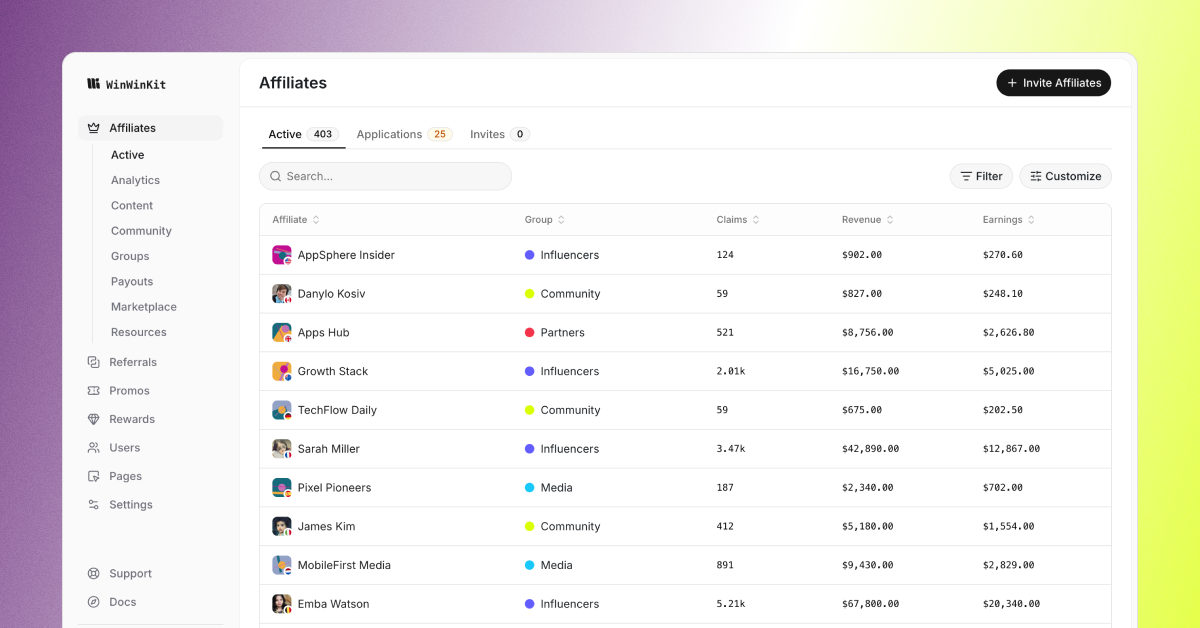
WinWinKit is an end-to-end solution for affiliate marketing in mobile apps. Rather than covering one slice of the problem, it handles the full lifecycle from a single dashboard:
- Recruit and manage affiliates. Onboard partners, set commission terms, and give each of them a unique code.
- Track claims and conversions. See performance per partner, not just a single program-wide total.
- Grant rewards automatically. Feature unlocks, credits, App Store Offer Codes, and RevenueCat offerings and entitlements.
- Pay out commissions. Calculated against real revenue and paid without manual bookkeeping.
The same integration also covers user-to-user referrals and promo campaigns, so you build one redemption flow in your app instead of three.
Integration in under an hour
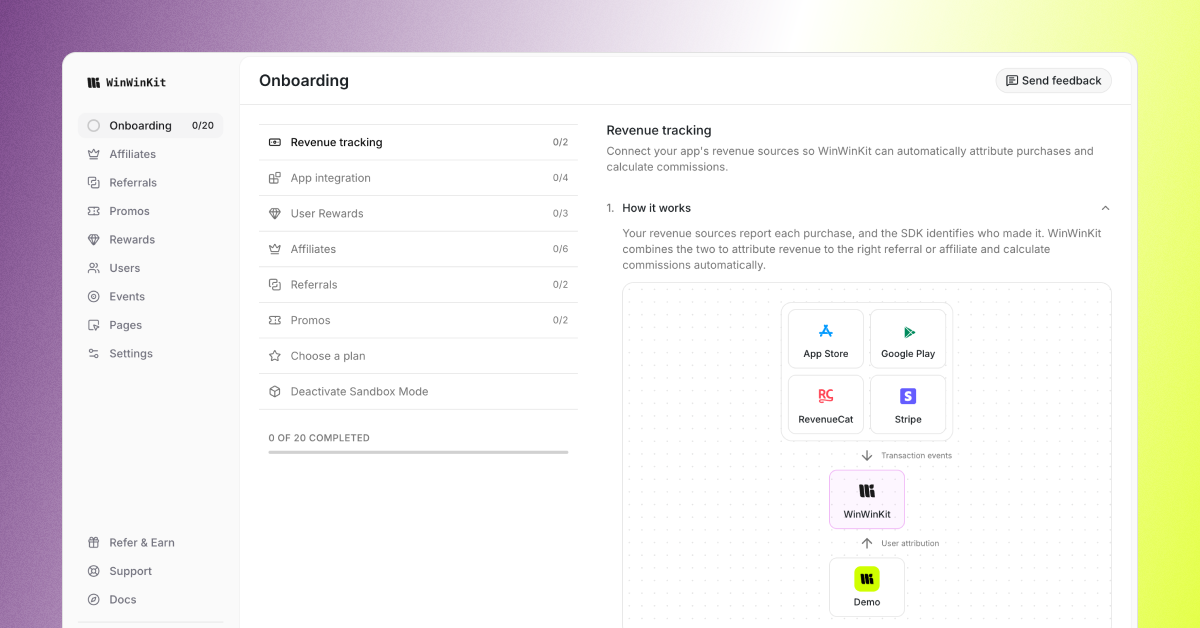
Getting started with WinWinKit takes an hour at most. A detailed in-app onboarding walks you through each step, from connecting your app and adding the SDK to setting up your first program and testing a code redemption end-to-end. You don’t have to piece it together from scattered docs.
WinWinKit is built by an indie developer
WinWinKit is built by Oleh Stasula, an indie developer who has been shipping apps for over 14 years and created the platform to help promote apps. The goal was to work with creators and reward them based on their actual contribution to an app’s growth. The tools available were built for e-commerce and the web, were too expensive, or covered only part of the job, which left the rest to be stitched together by hand. So Oleh built the tool that was missing. Today, apps of all sizes, from solo indie projects to established products with dedicated growth teams, use WinWinKit to grow through the people who already love them.
Coming soon: Marketplace
WinWinKit is launching a Marketplace where creators and affiliates can discover apps to promote. Instead of hunting for them one cold message at a time, your app gets listed in front of creators who are already looking for something to promote, and they can apply to your affiliate program directly.
Getting listed is free. If you run a subscription app and want early visibility once the Marketplace launches, sign up at WinWinKit to secure your spot.
Try out this app marketing method
Affiliate marketing for subscription apps is a low-risk, high-reward strategy in a competitive market. By partnering with motivated affiliates and using reliable tracking, you can increase installs, revenue, and engagement while only paying for outcomes you can verify.